
HERE, WE EXPLORE WHAT CAUSES SPLIT ENDS AND HOW TO PREVENT FURTHER DAMAGE.
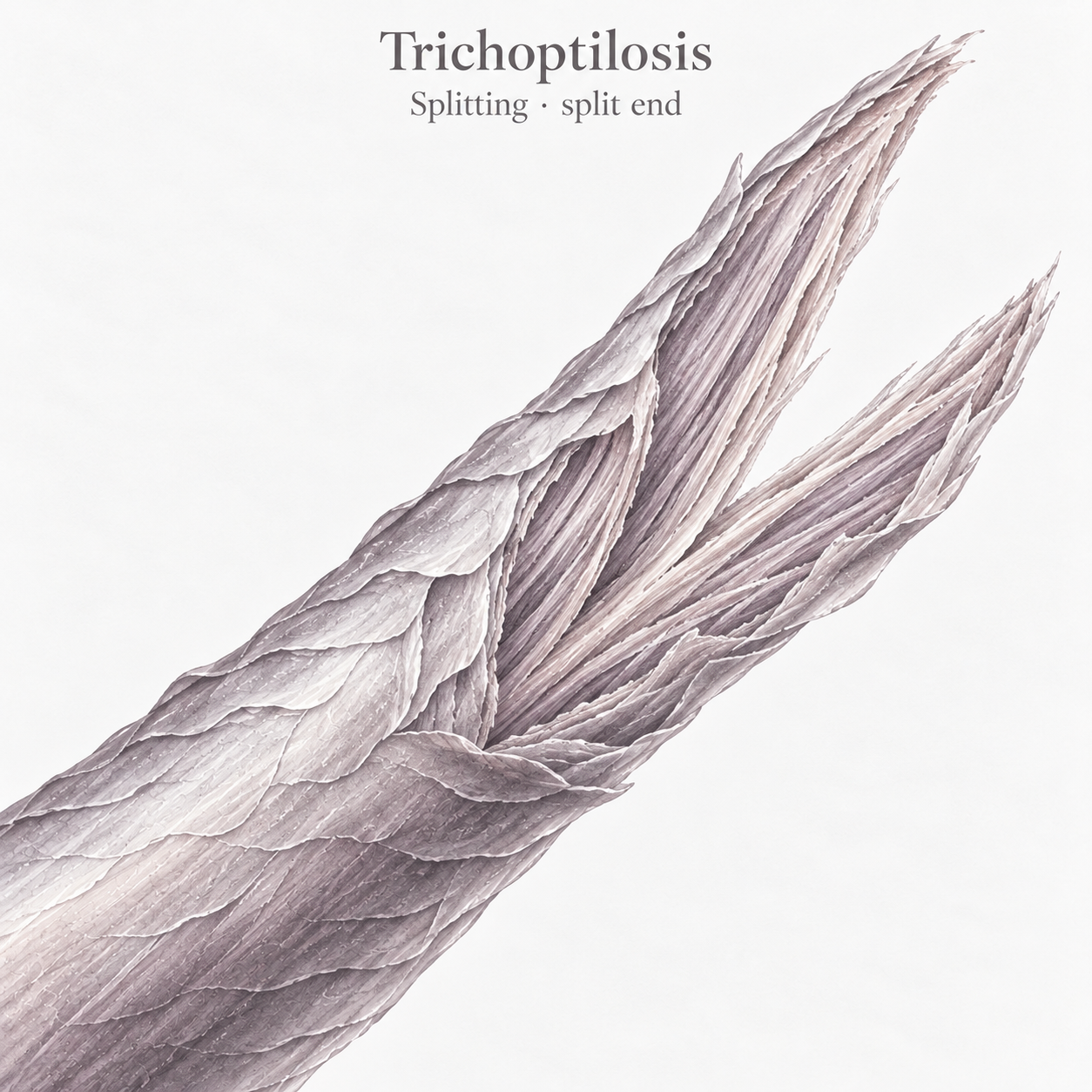
"Trichoptilosis" or "Schizotrichia" are the medical terms for split ends, which manifest as fraying or splitting of the hair fibre. Splitting typically starts at the ends, but it can occur anywhere along a hair strand.
What causes split ends?
All hair types can develop split ends, with some ethnicities, notably those of African heritage, more prone than others. Splitting most often happens when hair is overexposed to damaging factors, such as heat styling, chemical processes, and environmental pollutants. A surprising culprit is friction, which often happens when we rub our hair against a pillow or snag it under a handbag strap.
Once the very ends of the hair split, the split gradually travels further up the hair strand toward the root. Healthy hair fibres are wound together, but once a split occurs, they fracture and begin to unravel, like a fraying rope.
How to identify split ends?
Each hair strand has the same basic structure, with three distinctive layers: the medulla, cortex, and cuticle.
The cuticle is the outermost layer, made up of colourless cells that act as the strand’s protective shield. A healthy cuticle has tightly overlapped cells, giving the hair its smooth, reflective shine, but when the cuticle is damaged, it is no longer bound and sealed, and the strand's luminosity declines. The hair becomes less supple and smooth, and is instead dull, dry and straggly, with visible frayed ends.
Can you repair split ends?
Products can help condition and strengthen hair, making split ends feel smoother and look healthier. However, they cannot permanently repair a split. If the ends are badly frayed, cutting away the damage helps prevent further splitting.
Can your hair grow if it is split?
Many factors affect hair growth, but under normal conditions, the average hair grows 1.3 cm a month. However, when hair is already split, fraying at the ends can negate this growth. By trimming split ends and investing in a haircare plan to prevent future fraying, you can help your tresses grow long and strong.
7 tips to prevent split ends
Have regular trims: Even if you take great care of your hair, splitting will eventually occur over time. Regular trims are essential to keep the ends healthy.
Upgrade your shampoo and conditioner: Choosing the right shampoo and conditioner for your hair type can feel overwhelming. Research the brand and read the labels to understand the ingredients and where they come from. Always use products that are formulated for your hair type and concerns.
Invest in good tools: The quality of your heat tools matters, especially if you use them often. High-quality models last longer and reduce damage over time. And don’t forget: a heat-protection mist or spray is essential! Reduce how often you reach for heat tools by experimenting with quick, simple, heat-free styling techniques.
Try a microfibre towel: Vigorous towel drying can damage your hair. Use a microfibre towel instead: they're more absorbent and much gentler on your hair, helping you dry your lengths quickly without friction or snagging.
Use a wide-tooth comb: Brushing hair when it’s wet can cause severe damage. If your hair is very knotty, detangle it with a wide-tooth comb before rinsing out your conditioner. Always start at the bottom and gently work your way up in sections to the root.
Try a leave-in conditioner: Leave-in conditioner is ideal for keeping your hair hydrated throughout the day, sealing and protecting each strand while adding shine.
Switch to silk: As we mentioned earlier, friction damage is a key culprit behind split ends, so be mindful of how you place and position your hair. Invest in a silk hairband so you can gently tie it up without causing friction.


© 2026 The Hair Consultancy